
Ellen Seeling
An excerpt from "Freedom of Expression: Interviews with Women in Jazz"

I’m saddened to hear that trumpeter, conductor, educator, and activist Ellen Seeling passed away. I saw the news on Facebook last week. While putting this post together, I searched back through our email correspondence over the years, and the first thing I came across was a note from Ellen with the subject line, “You ok?” and “Hey sup dude?” in the body of the message. She was checking in on me when Hurricane Harvey hit. Ellen was like that. She looked after people. I replied (amazingly, we hadn’t lost our Internet connectivity), assuring her we were on high ground, the National Guard had arrived, and our cat was “chill.” (Ellen loved cats.)
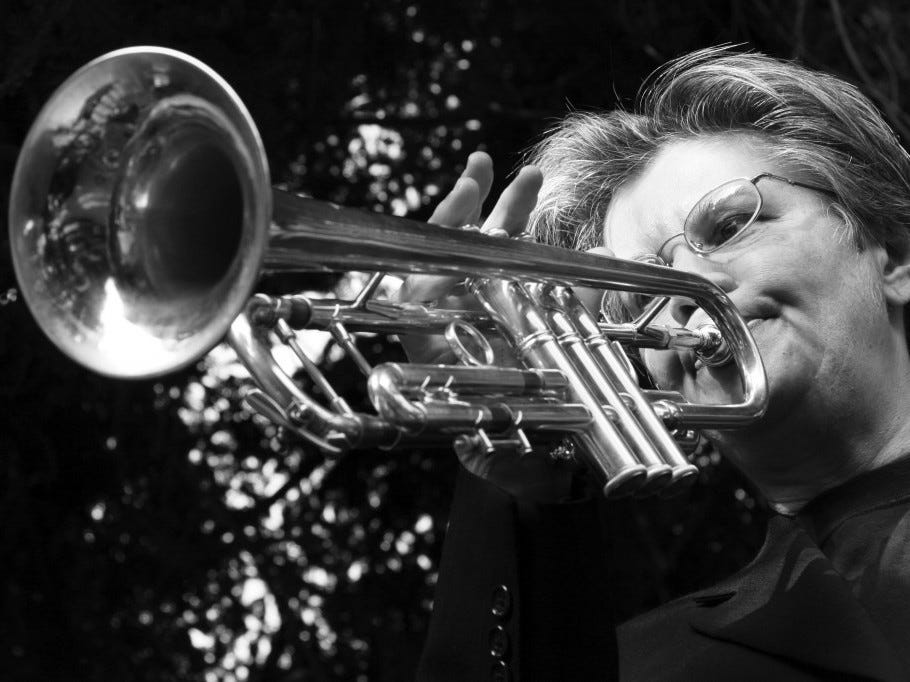
(Ellen Seeling. If anyone can tell me who took this photo, I would appreciate it!)
Ellen was such a strong supporter of my book Freedom of Expression: Interviews With Women in Jazz, and her interview, an excerpt of which appears below, is enlightening, especially for a generation used to jazz being a matter-of-fact offering in academia. It’s also at times angry, funny, tough, but never cynical, and ultimately, inspiring. She discusses her early days at Indiana University, her first professional gigs, including a life-changing experience with the rock band Isis, and shortly thereafter, a phone call and audition for the one and only Laura Nyro. I’ve updated the original introduction slightly and included some helpful links.
P.S. After reading this, you might want to check out Ellen as a guest on the legendary Marian McPartland’s show Piano Jazz!
Ellen Seeling
An excerpt from Freedom of Expression: Interviews With Women in Jazz.
While a small number of musicians demurred after being contacted with a request for an interview for this book (some expressed being “burnt out” on “women's” projects), several did welcome the opportunity to be a part of a project solely focused on the contributions of women to jazz. That said, the majority of these interviews are about music, not gender. However, the following interview with trumpeter, bandleader, educator, and activist Ellen Seeling is an example of an in-depth conversation that unapologetically embraces both subjects.
In 1969, Seeling was accepted into Indiana University, one of the top five music schools in the U.S., and was the first woman to graduate from IU with a jazz degree. (“Bachelor’s of Music in Jazz Studies is the official name on my diploma,” says Seeling.) While still in school, she recorded and toured with the legendary all-female progressive rock band Isis (named after the Egyptian goddess), one of two all-female rock bands based in New York City at the time with a record deal (the other being Fanny, led by guitarist June Millington).
The experience was life-changing and led to her being asked to tour with singer-songwriter Laura Nyro in a band that included jazz musicians Mike Maneri on vibraphone, Richard Davis on bass, and Andy Newmark on drums. Both opportunities coincided with the rise of the next wave of the women’s rights movement and were empowering for Seeling both as a musician and a woman.
Born in Wisconsin, Seeling relocated to New York City in 1975, and since then, has enjoyed a successful and wide-ranging career performing and recording with musicians across the musical spectrum of jazz, rock, and funk, all while remaining a vocal advocate for women’s rights, especially when it comes to the bandstand and academia. After relocating to the West Coast, Seeling and her partner, saxophonist Jean Fineberg, founded both the Jazzschool for Women and the Girls’ Jazz and Blues Camp to provide music education opportunities for women in a supportive environment. In 1997, Seeling and Fineberg founded the Montclair Women’s Big Band, which features some of the most talented women jazz players in the Bay Area. Seeling is also the chairperson for Jazz Women and Girls Advocates, a relatively new organization dedicated to promoting “the visibility of women and girl instrumentalists of all ethnicities in jazz and to advocate for their inclusion in all aspects of the art form.” JAGA’s legal pressure concerning the 30-year absence of women in the Jazz at Lincoln Center Orchestra resulted in JALC’s adoption of blind auditions. This past April, Ellen was recognized as the Jazz Journalists Association’s 2025 Bay Area Jazz Hero, a well-deserved and long overdue honor for her unrelenting commitment to high musicianship and women’s rights.
Seeling’s activism and formidable musicianship continue to inspire both women and men who believe jazz is a progressive, not regressive, form for artistic expression. But I can’t help but wonder what opportunities for women in jazz would be like without Seeling and others like her who are speaking out against gender discrimination in jazz. I also wonder what, if any, changes we will see in this field a decade or two into the future.
You were the first woman to graduate from IU with a degree in jazz studies.
Bachelor’s of Music in Jazz Studies is the official name on my diploma.
Did you go to New York City right after graduating?
I was sort of back and forth for a while. I dropped out for a year because they kept raising the tuition and I couldn’t afford it, even though I was working. At one point, I was working something like 32 hours a week, taking out loans and getting grants but still barely making tuition and paying my living expenses.
And the program there was very rigorous. I couldn’t slack off on the practicing and all the other stuff. So, I dropped out for a year so I could get my residency status and come back to school and pay tuition as a resident. During that time, David Baker was nice enough to let me continue to play in the ensembles and audit some classes.
In December of my senior year, I got a call from Carol MacDonald, who was the lead singer of Isis, one of the first all-woman rock bands in New York City with a record deal. There were just two all-female rock bands in New York at that time. One was Fanny, led by June Millington, who is still around, and the other was Isis. Both bands were what they called back then progressive rock bands. Isis had a horn section, kind of like Chicago or Blood, Sweat & Tears. Carol had gotten my name from [tuba and baritone saxophone player] Howard Johnson, who had come to IU to do a clinic with the big band. I believe I was the only woman in any of the big bands, and possibly the only woman in the jazz department at that time. I was getting to play and do some soloing, and he heard me. Isis was going to record an album in New Orleans with Allen Toussaint producing in Toussaint’s new studio, but their regular trumpet player couldn’t do it, and she was looking for a replacement. On Howard’s recommendation, Carol called me up and asked me to go to New Orleans with
Isis, sight unseen, because there just wasn’t anybody else in New York who could do the gig. I mean, this is how scarce women jazz and commercial trumpet players were back then.
Isis flew me down to New Orleans over Christmas vacation. I met and hung out with the band and spent all day and all night in the studio for about two weeks and did my first record. I think that was also my first time on an airplane! It was very heady! [laughs] A total rush, you know? Talk about getting hooked on something!
That’s an amazing story. Did recording with Isis lead you to decide to move to New York City and dive into the world of playing commercial music?
Well, sort of. After I finished the album, I went back to Indiana to finish my degree. A month or two later, Carol called me again and said, “The band is going on the road this summer and we need a trumpet player. Are you interested?” I said, “Sure!” I managed to work it out with David to finish up all of my coursework ahead of schedule so that I had time to complete my degree and make it to New York in time to head out on the road with this crazy women’s rock and roll band.
Isis toured for the summer. I had applied to go to graduate school at IU as a trumpet performance major. (The school didn’t offer a graduate jazz degree at that time.) When school started in August, I left the band and went back to IU, but you know, it was never the same after that. [laughs] I was just never the same. I started working on my grad degree in trumpet, but I was stuck studying all this stuff I didn’t want to study, learning all this repertoire I didn’t want to learn, and that’s when this crazy series of events happened to me, and I don’t know why.
I was at IU, feeling pretty miserable, when I got a phone call. I picked up the phone and it was Laura Nyro. I don’t know if you know her music.
Oh, yes. I do!
At first, I thought it was a hoax. I picked up the phone and a voice said, [gently] “Hello, this is Laura Nyro.” I waited a second and said, “Yeah, right! And I’m Miles Davis and I have to go now. Good-bye.” And I hung up on her! A few minutes later, the phone rang, and it was her, again, and I thought, “Maybe I should talk to this person?”
The conga player in Isis was a very good friend of Laura’s, and Laura was getting ready to do a big comeback. She decided she was going to go on the road and do a series of live recordings, and that her band was going to be a jazz band. Alex Foster was her horn player, and the rhythm section included Mike Maneri on vibes, John Tropea on guitar, Richard Davis on bass, and Nydia Mata from Isis on congas. Laura told me Alex was leaving, and asked if I would be interested in auditioning for her horn section. Although I had no idea what she had in mind, I said, “Hell, yes!”
She also called Jean Fineberg, whom I had met in Isis, who played tenor saxophone and flute. Laura’s plan was to replace Alex with two or three horn players.
To get ready for the audition, I went out and bought her latest album, Smile. There were several tunes on there she wanted me to learn by ear. She didn’t send me any music. Michael and Randy Brecker played the horns on that album. She flew me to her band’s first gig at Symphony Hall in Philadelphia, and my audition was to do the sound check with the band, which consisted of all of these guys, these big name musicians I had been listening to since high school. If I sounded good at the sound check, I had the gig.
It was very scary but I was not one to back down. I just sort of did it, and Laura seemed to think I was okay. I played the show that night, and then she offered me the gig, which ended up being a year’s worth of recording and live performances around the country, including Carnegie Hall.
I went back to school and checked in with David Baker about this gig, this gig that was like a gig from heaven. It paid decently, I was going to be playing with a dream band and travel all over the country, and it was my entrée to New York City. After the tour, I would have enough money to move to New York. But David Baker told me, “Don’t take the gig. Stay in school.”
Wow! That surprises me!
I thought about what he said and realized that this gig was the reason why I went to school, to be ready for an opportunity like this. So I left school, went to New York, and I never went back.
Do you think David Baker wanted you to finish the graduate degree in order to become an educator like him?
Well, I don’t know what he was thinking. I had a very different perspective on what he said then than I do now. Back then, I was in my early 20s, and I thought maybe he was looking out for me. But I remember, as a grad assistant, he gave the jobs of running the other bands and teaching classes to the guys.
My job as a grad assistant was basically to be his secretary in his jazz history class, even though I was just as good a player, had been around longer, and had a better professional track record than the guys. So, I didn’t really think about it then. But as I got older, I got more and more angry about the whole thing. I’m so glad I didn’t take his advice.
Even today, this is something musicians run into, where they begin playing professionally while they are in school and ask themselves if they should finish their degree or drop out. But it’s important to put your story and this decision you made into a historical context, with the women’s rights movement developing as you were evolving as a musician.
I never saw another female play the trumpet until I went to IU where there were two other women in the music program: Sandy Steinberg, who’s in L.A. now and is still playing, and Michelle Kaufman, who was a classical player. She was a monster player, the best classical player at IU while I was there. By the time I got to New York, there were two other commercial female trumpet players that I knew about, one being Laurie Frink, who was a really well-known, well-respected trumpet player. She and I knew each other and played together.
Growing up, it was very daunting to not see many other women like me playing the trumpet, but I just kept going. I figured I could do it. I loved music, and after playing with Isis and Laura Nyro, I had a support system of other women musicians. I had a support system, and it kept me going.
At IU, did you have a similar kind of support system? Did you hang out and jam with other jazz musicians?
I’m sure the program at IU has since evolved but back then, there were some glaring omissions in the jazz degree programs. We did not get any combo instruction. The combo thing went on in the practice rooms with the guys, after hours, and I was not invited to those things. But between going to school and working different jobs, I didn’t have time to stop to think about the things that were going on around me, like, not getting invited to jam sessions. I just worked as hard as I could to get what I wanted.
When I got out of college, I became more aware of our situation as women performers in music, particularly in commercial music and jazz. Hanging out with the older women in Isis was a really good education for me. The original core group of Isis had played together previously as Goldie and the Gingerbreads.
I’ve heard of them. Sort of inspired by the British beat music, right?
Yes. They opened for and toured with the Rolling Stones in Britain and had some radio hits. Three of the women in that band became the core of Isis. Goldie was Goldie Zelkowitz, now Genya Ravan, who is a pretty well-known singer and record producer. The keyboard player was Margo Lewis. She went on to run her own talent agency, Talent Consultants International, and managed Bo Diddley for 25 years or something—she still manages his estate. Ginger Bianco was the drummer. Carol MacDonald was the guitar player and became lead singer of Isis.
These women were powerful. They knew who they were. They knew that the business was messed up, and they just hung together. That was a powerful bunch of women to be around in the 70s. I was really lucky to get in with that group. It was a wonderful support system and gave me a lot of opportunities to play in front of large audiences.
I don’t know if anyone else has opened up this topic for you, but I think an unspoken but very important aspect, or characteristic, or quality of a lot of women musicians who are well known, or somewhat well known, or able to make a living playing jazz is that they are lesbians. I think part of what kept them going was their connection with other women and not caring that much about what the guys thought.
It’s sort of unspoken in women’s sports and in women’s music that a large percentage of the women are not straight. I think that tends to help them bond with each other in a way that may be different than straight women. Not that I don’t have a lot of straight women friends and colleagues whom I love. Most of the women in my band are straight. But there’s a connection and level of support that goes really, really deep among women who do not rely on men.
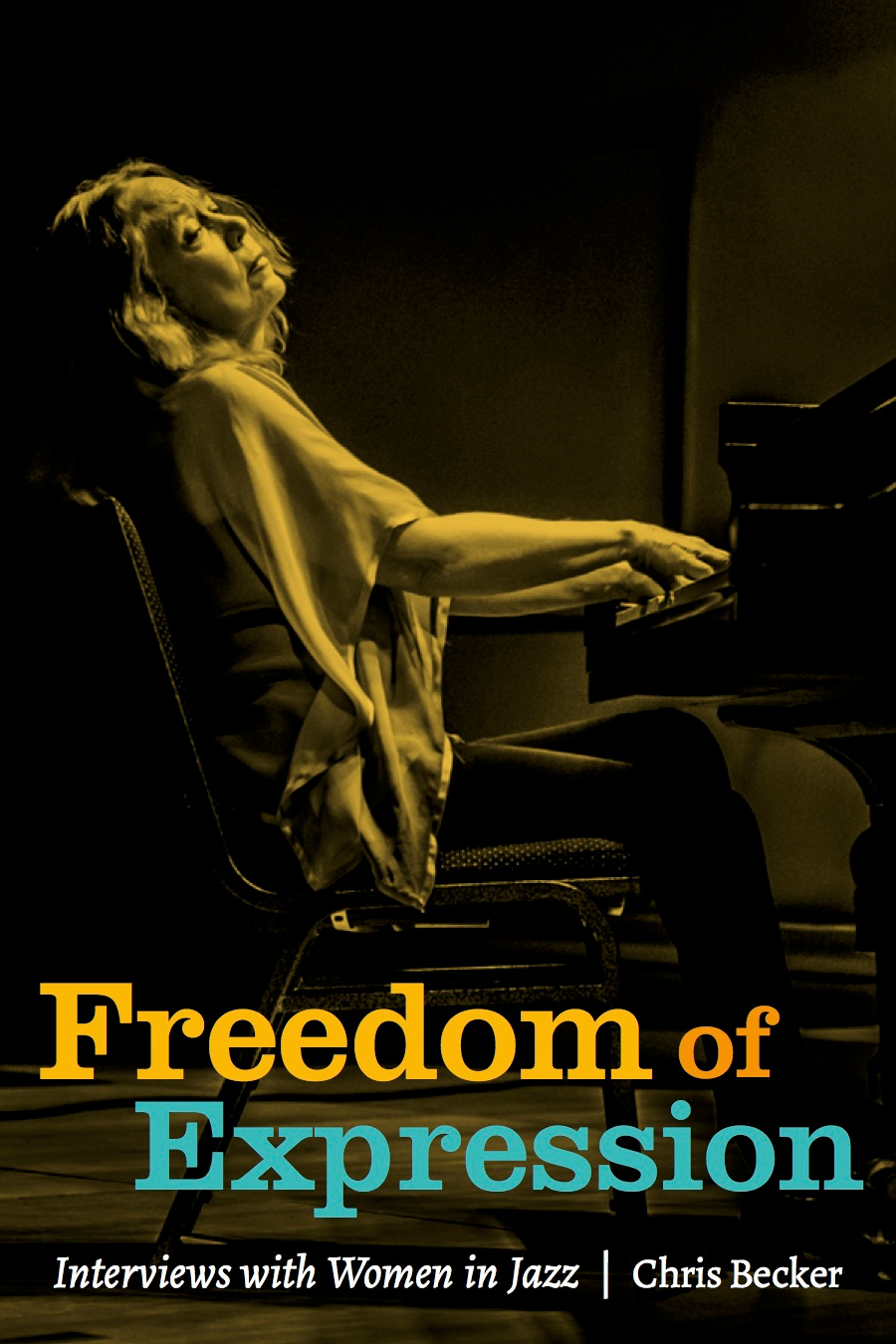
Freedom of Expression: Interviews With Women in Jazz is available for purchase from Amazon and The Jung Center of Houston Bookstore.
Published in 2016, Freedom of Expression is a collection of interviews I conducted with 37 female musicians of all ages, nationalities, and races and representing nearly every style of jazz one can imagine. The interviewees include Eliane Elias, Terri Lyne Carrington, Anat Cohen, Diane Schuur, Cheryl Bentyne, Mindi Abair, Connie Crothers, and many, many other incredible musicians.
(Cover photo of Connie Crothers by Peter Gannushkin.)