
Parting Glances (1986)
A brave and comedic film about love and mortality in the time of AIDS.

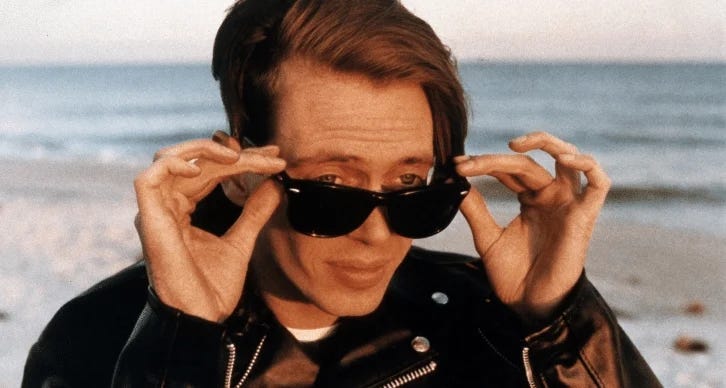
(Steve Buscemi as Nick in Parting Glances (1986))
Earlier this month, I wrote about Wings of Desire (1987), a film I figured many Night and Day readers had seen. In contrast, I will hazard a guess that many of you have not seen Parting Glances (1986), which is excellent and easy to find on streaming services, and I’m happy to write a little bit about it for Pride Month. Written and directed by first-time filmmaker Bill Sherwood, and made with a shoestring budget, Parting Glances was a pioneering work of gay cinema and may be the first film that dealt with AIDS and its devastating impact during the Reagan years at the height of the pandemic. It’s also very funny. No spoilers here, but several scenes still make me laugh. There are also some truly poignant moments that anyone who has enjoyed a great friendship, a passionate love affair, and/or an emotionally intimate marriage will relate to.
Of course, when I first saw Parting Glances, at the tender age of 18, I had no experience with any of that stuff. The film screened the year of its release in Columbus, Ohio, at the Drexel Theater, an Art Deco-styled theater located literally across the street from the campus of Capital University, where I was a Music Theory and Composition major, with piano as my main instrument. 1986 wasn’t that long ago, and I can tell you that back then, college campuses, at least in the Midwest, did not have much in the way of resources and support for LGBTQ+ students. As a straight guy who was pretty shy, didn’t drive, and still acquiring some basic social skills, my experience with that community, or any community for that matter, grew the more I composed music, and expanded my creative activities beyond Capital’s campus to include collaborations with students at Ohio State University’s Department of Dance, and scrappy, multidisciplinary performances in the city’s art galleries and alternative spaces. But before gaining a little more life experience, Parting Glances was an education for me, as it was a nuanced portrayal of gay life without negative stereotypes.
Set in New York City and taking place over the course of 24 hours, the film begins as Upper West Side couple Robert (John Bolger) and Michael (Richard Ganoung) prepare for Robert’s departure to Ghana for a two-year work assignment. They share an affectionate, close bond, but it quickly becomes apparent that the relationship has become a bit stale. Maybe even boring. Meanwhile, Michael’s first love, an MTV-era rocker named Nick (Steve Buscemi), is HIV positive. Further complicating the tension between Robert and Michael is the fact that, as Nick’s condition deteriorates, Michael will be left to care for him on his own.
Robert is scheduled to leave the next morning, but before that, he and Michael will head out for dinner with Robert’s closeted boss, drop in on a surprise going-away party hosted by their friend Joan, a struggling artist with a penchant for cocaine (played by Kathy Kinney in her first film), and meet the dawn dancing at a gay club to the music of the British synth-pop band Bronski Beat.
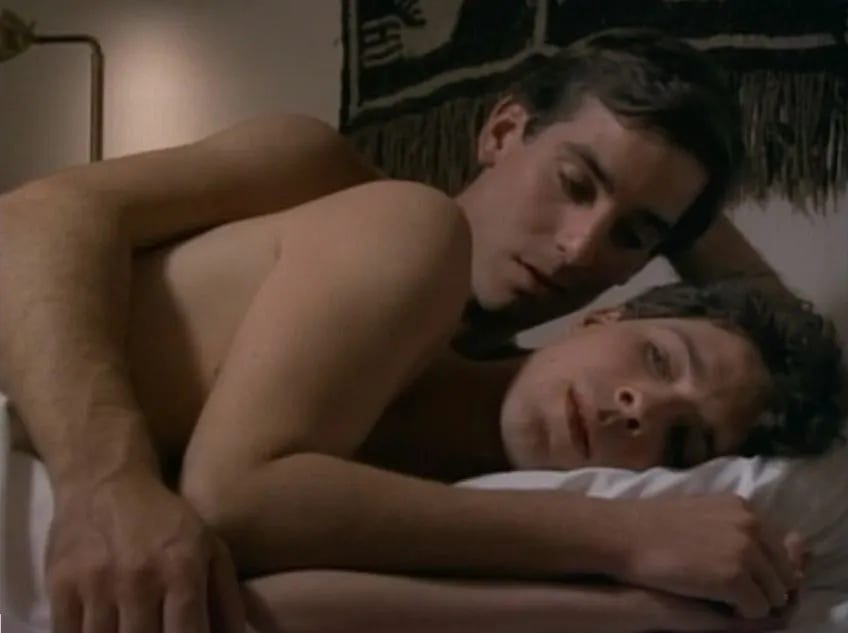
The going-away party is a tour de force of screen writing, acting, and editing, and is still unmatched in cinema in how seamlessly it tells several stories through brief moments of conversation between one character and another, be they straight, gay, or who the hell knows and who the hell cares, while maintaining an atmosphere of communal celebration. But there’s tension as well. Nick, who has been holed up in his neon-lit, television-filled apartment, waiting for his video to broadcast on MTV while trying to ignore the sounds of his neighbors having loud sex, shows up at the party unexpectedly, much to the delight of several friends who have been concerned about him. Later, Nick pulls a switchblade on an especially crass party goer, who expresses a creepy and wholly inappropriate fascination with his HIV positive diagnosis. Meanwhile, Robert sneaks off for a tête-à-tête with an ex-girlfriend from college, leaving Michael, who eavesdrops on their conversation, feeling dejected and more unsure of the future than before.
For those of you who first encountered Buscemi as the whiny and wily "Mr. Pink” in Quentin Tarantino’s Reservoir Dogs (1992), his performance as Nick will be a revelation. Unlike pretty much every other role Buscemi has played on screen since then, in Parting Glances, his character is charismatic, street smart, and yes, at times, sardonic, but in other scenes, quite vulnerable. In 1986, Buscemi was a former firefighter with very little professional experience as an actor, and apparently his audition for the role of Nick was a disaster. But Sherwood was aware of Buscemi’s talent as a stage actor, and told him if he wanted the role, it was his. (Sadly, Sherwood died of AIDS-related complications in 1990 at the age of 37.)
Another unexpected guest at Robert’s going-away party is Peter, a young man Michael met earlier that evening while buying Nick some opera on vinyl. (The Mozart aria “Don Giovanni. A cenar teco m’invitasti” is used to great effect in the film.) Peter’s presence is not without some drama; he’s good-looking, and basks in plenty of attention, but quickly manages to piss off just about everyone in attendance, mainly because he’s a young kid who doesn’t know when to shut the f-ck up. (Don’t pretend. You know you’ve been that kid.) Peter and Nick’s conversation in a stairwell outside of the Joan’s loft is an awkward, almost painful exchange between two generations, one naive and exuberant, the other resigned and world-weary. You’re left to wonder what will happen to Peter after he suddenly flees down the stairs and into the New York night. (Tellingly, Peter rebuffs Nick’s offer of cab fare.)
There’s so much more I could write about this film, but then we’d get into spoilers, and I don’t want to ruin anything for the first-time viewer. I will say, regarding the levels of hostility and violence directed at the LGBTQ+ community, I wonder some days how much has changed in our culture for the better since the Reagan years. Some days, it can feel pretty bleak. But this film, like all great art, pushes back at those feelings of hopelessness, and remains as a testament to our shared humanity, like a note, passed from one person to the next, with a message to be brave, stand up for your friends and for strangers, and live life without apology or fear.
What a brilliant read about a movie that I have indeed seen, more than once, but not in a very long time. You have put it right at the top of my watch-again asap list. When it came out, I was already pushing 40 (!), and had already been out and about myself in the gay world for quite a few years - and was already losing friends and acquaintances to AIDS. I still remember what an impact the movie had on me then, even though I can't remember the details. But that not-remembering will be rectified this very evening. Thank you!
I must see this film! Thank you for the beautiful insights into this work!