
Blue, Blue, Electric Blue
The blue room in David Bowie's "Sound and Vision" as a metaphor for healing.

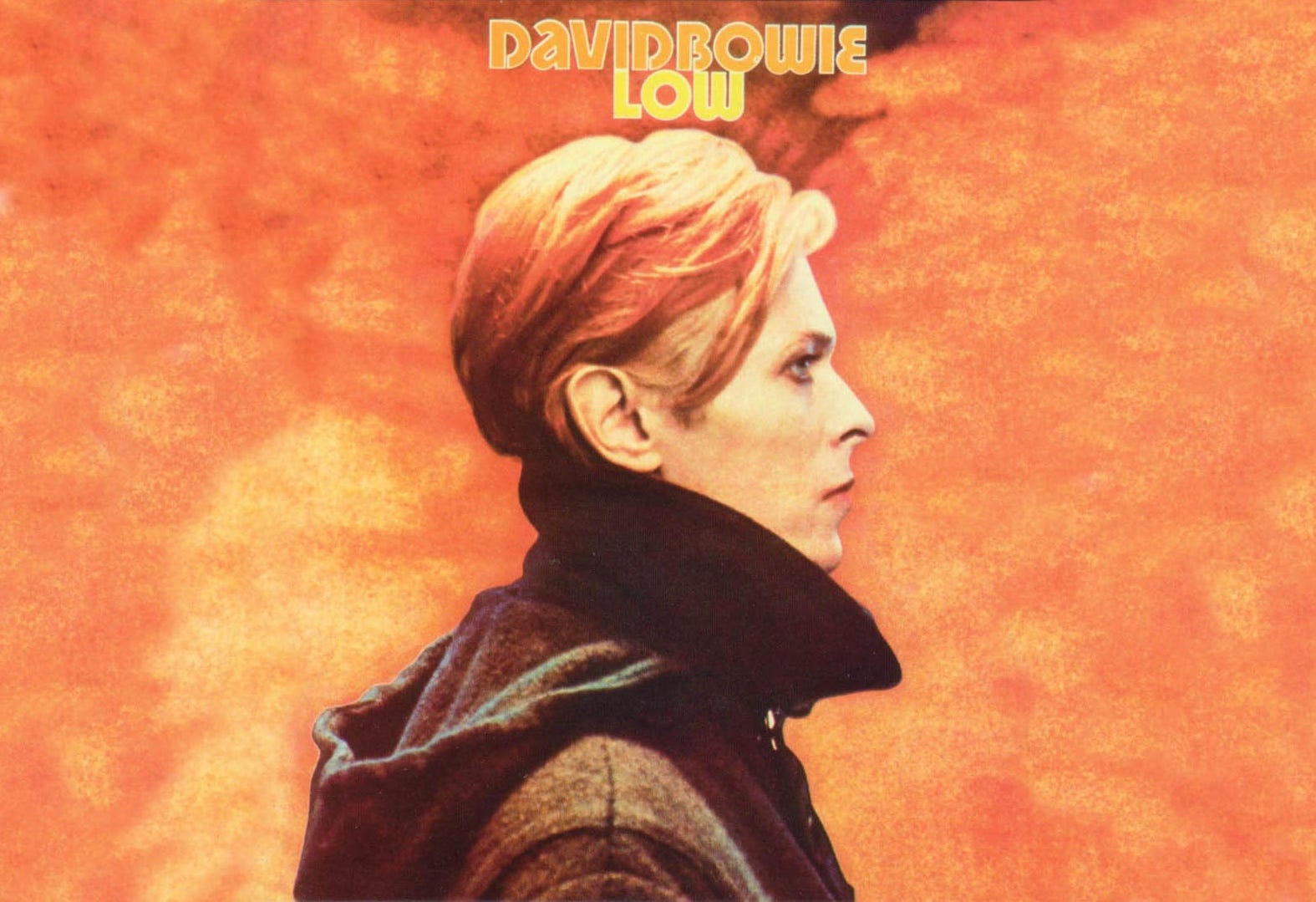
(David Bowie, Low, 1977, RCA; album cover design by George Underwood.)
I find it so inspiring when I am reminded that much of the music I grew up with has the capacity to resonate with much younger listeners, especially those who have experienced and are healing from physical and mental traumas. In a recent video for his Creative Arts Therapy YouTube channel, creative arts therapist Enrico Curreri, who works with patients ages 10-17 carrying different diagnoses, including major depressive disorder, autism spectrum disorder, and childhood-onset schizophrenia, describes how in therapy, music often becomes a mirror. “Not always through words,” says Curreri, “but through space, tone, and feeling.” As an example, he points to David Bowie’s song “Sound and Vision” from the 1977 album Low. Curreri describes how his teen and tween patients living with depression and disassociation recognize “the blue, blue, electric blue” room in the song’s lyric as a familiar place of stasis, where one sits and waits for the light. Despite the track’s upbeat groove and collaged call-and-response vocals, which range from smoothly crooned harmonies to desperate howls, there is an underlying “tone” and “feeling” to the track that Curreri describes as “Not sadness, exactly. But stillness.” The album cover of Low is orange, as is Bowie’s hair, but the color of “Sound and Vision” is blue.
Bowie recorded Low at time when he felt creatively and spiritually drained. Years of cocaine abuse had wreaked havoc on his physical and mental health, although amazingly, despite his escalating state of addiction and psychosis, Bowi had managed to record a hit album, Young Americans (1975), followed by the powerful Station to Station (1976). In a thoroughly entertaining and enlightening 1998 interview with Charlie Rose, a much healthier Bowie describes leaving Los Angeles for Europe in 1976, accompanied by his close friend Iggy Pop (real name James Osterberg), as an attempt to navigate his way out of this overwhelming darkness. “We both had fairly severe drug problems. So, to rectify that, we moved to (West) Berlin, the heroin capital of the world! Which, I guess in retrospect, doesn’t sound like a terribly sensible thing to do.”
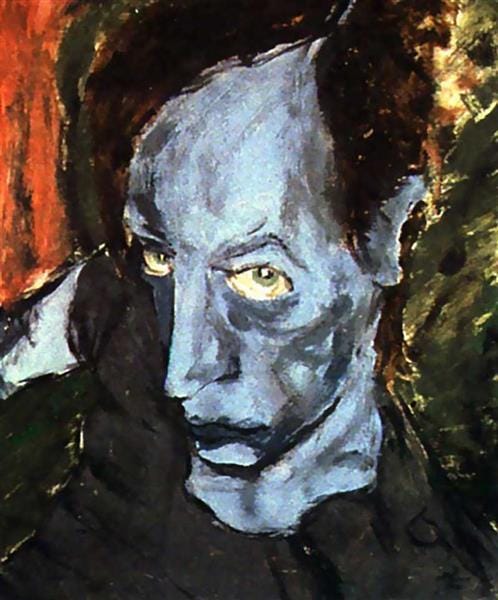
(David Bowie, Portrait of J.O., 1976.)
Heroin capital or not (Editor’s note: Most of Low was recorded at the Château d’Hérouville in France.), Bowie did have the sense to realize the time had come to let go of old habits and rigid thinking to allow for some kind of rebirth. To help with that process, he found a trusted collaborator in musician and multimedia artist Brian Eno, who introduced Bowie to new concepts and tools for composing and recording music, including a deck of cards called “oblique strategies,” each of which provides gnomic suggestions for next steps in the creative process. (Such instructions include “Honour thy error as a hidden intention,” “Reverse,” and “Emphasize differences.”) The resulting album, with its moody, second side devoted to four instrumental compositions, was released a week after Bowie’s 30th birthday. Not surprisingly, it didn’t sell well. However, its innovative use of synthesizers and highly processed sounds went on to inspire countless post-punk bands, including Joy Division, The Human League, and Cabaret Voltaire, as well as composer Philip Glass, whose Low Symphony (1992) builds upon themes from the album’s instrumentals. Eno and Bowie continued their collaboration with “Heroes” (1977) and Lodger (1979), which, along with Low, came to be known as the “Berlin Trilogy.”

(Photo by Dan Senior on Unsplash.)
“Many patients describe this ‘blue room’ as a familiar place,” says Curreri. “A state of inner numbness . . . a limbo of disconnection.” In a creative arts therapy session, Curreri invited his patients to visualize the “blue room” and, using soft pastels, watercolors, and sound therapy instruments, share what “a space of emotional pause” looked like to them. Many of the artworks his patients created included small windows or doors, portals where the light might eventually reach them.
For Curreri and his young patients, the “blue room” is a metaphor for healing, “Bowie isn’t demanding joy, he’s simply waiting,” says Curreri, “and in that waiting, we find grace.” As one patient told him, “I stopped trying to push through the fog. I just sat with it. And in time . . . light started coming in.”
For more about creative arts therapy, check out my extended interview with Curreri here on Night and Day.
In the waiting we find grace 🙏🏾❤️
Wonderful insights! Thank you!!